 Himeji Castle Ticket
Himeji Castle Cherry Blossoms: The Full Bloom Guide
One week a year, the Himeji Castle cherry blossoms turn the White Heron pink - and the whole Kansai region comes to photograph it. This guide covers the bloom calendar, the castle's sakura geography, the crowd reality without varnish, and the ticket strategy that keeps the week survivable. The castle's own entry rules sit in the official ticket guide; this page is the bloom-week manual.
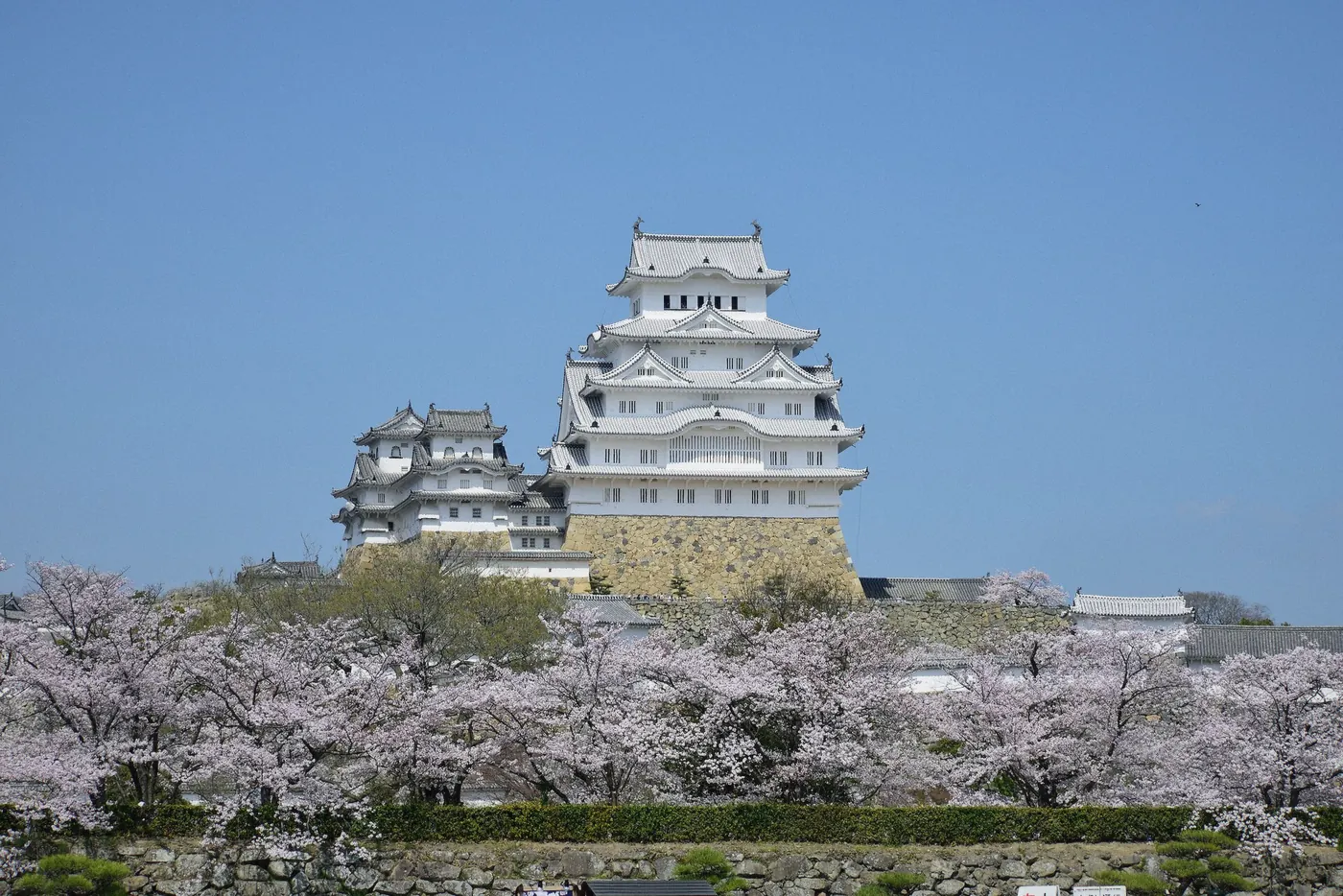
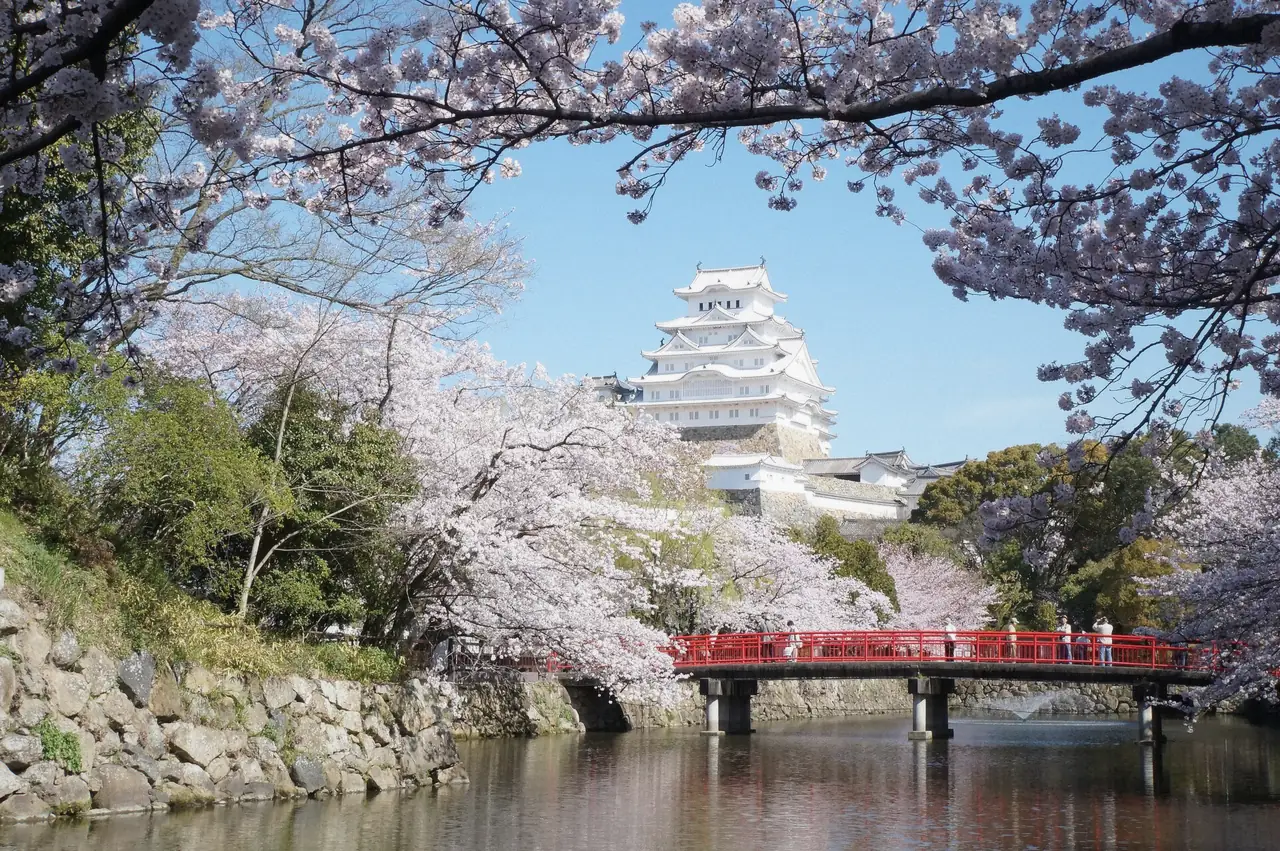
The classic bloom composition - the keep over a cloud of pink. Photo: Seattleite7, CC BY-SA 4.0, via Wikimedia Commons.
Quick answer One week of peak bloom, festival-density crowds, and a dawn plan that works
Key takeaways
- Bloom lands late March to early April - peak about one week, forecast by the city in early March; the moat rows and Nishi-no-Maru carry the classic shots.
- Crowds are the real weather: grounds full from dawn, keep queue constant all day - the 9:00 entry with a dated official ticket or the earliest guided slot are the only two workable shapes.
- Book two months out: bloom weeks sell the small-group formats by calendar - the seven-seat walks and the four-seat boat go first.
When the Blossoms Land
The calendar, honestly
Himeji's some-1,000 cherry trees open with the Kansai curve: first buds mid-to-late March, full bloom typically the last week of March into the first week of April, peak canopy about one week, and a petal-fall afterlife that has its own beauty and a fraction of the crowd. The exact dates move with the spring - a warm March pulls everything forward, a cold one stretches it - and the city's blossom forecast (published early March, updated weekly) is the calendar that matters. Booking flights around a forecast is a gamble; booking a trip that is excellent even at 70 percent bloom is the local strategy, and Himeji - castle, garden, sake district - is exactly that.
The Castle's Sakura Geography
Where the classic views sit
Three zones make the bloom postcards. The outer-moat rows: cherry lines along the water with the keep rising behind - the walk from the station becomes the first photo spot a week before the keep does. Nishi-no-Maru, the west bailey: lawns under the walls where the blossom-and-stone compositions stack, and the long galleries frame pink through the gun-slots.
And the third-bailey heart, where picnic sheets appear at dawn and the keep photographs over a sea of pink from every angle. Koko-en joins late - its own blossoms are good, its wisteria better - which is one more reason the garden hour belongs late in a bloom day.
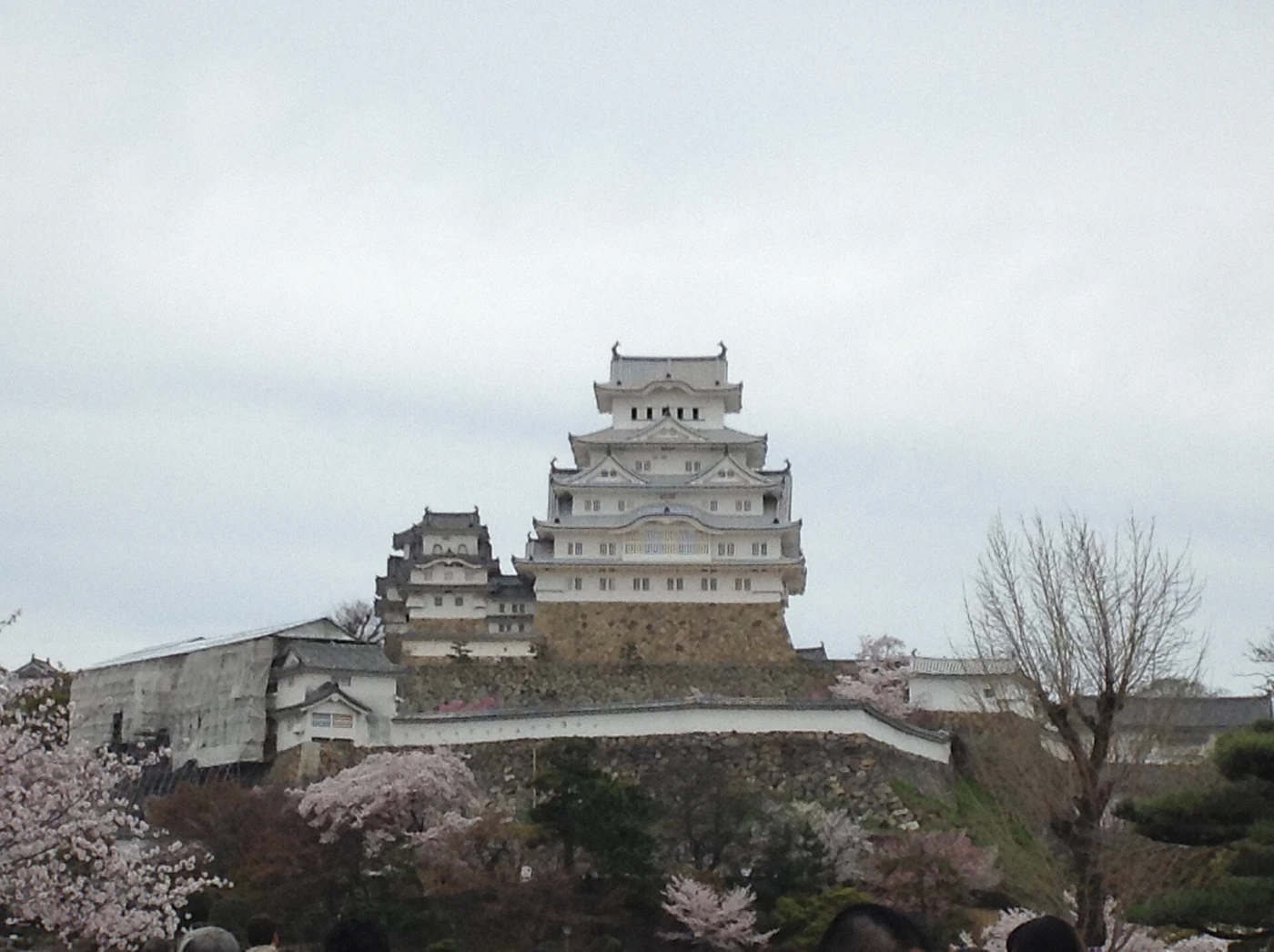
Nishi-no-Maru's lawns and walls stack the blossom-and-stone compositions. Photo: ヤマビーバー小僧, CC BY-SA 4.0, via Wikimedia Commons.
Crowds and the Dawn Strategy
What peak week actually feels like
Festival density, said plainly: the grounds are full from first light - bloom-week dawn walkers arrive at 6:00 for the empty-moat photographs - and the keep's staircase queue runs constant from the 9:00 opening to the 16:00 last entry. Picnic culture is the local rhythm: sheets in the third bailey from morning, food stalls along the approach, and a festive (not hostile) crush. The strategy is not to beat the crowd but to arrive before its metabolism: 9:00 keep entry puts you ahead of the tour waves; by 10:30 the stairs are a shuffle.
Alternatively, invert the day - keep at 15:00 when the picnic crowd has peaked, garden at golden hour, light-up after dusk.
The hour-by-hour bloom-day shape
- 06:00-08:30: the free show - moat rows and Nishi-no-Maru at dawn, empty and luminous.
- 09:00: keep first, official ticket in hand; the queue is shortest it will be all day.
- 11:00: Koko-en for the wisteria-and-maple counterpoint, plus the teahouse.
- 12:30-15:00: picnic-lane lunch in the third bailey; the crowd becomes the spectacle.
- 15:00-16:00: second keep window if your legs and the queue agree; light-up after dusk, free, and the trip's quiet highlight.
Ticket Strategy for Bloom Weeks
What the week changes about entry
Nothing mechanical - the castle has no bloom-week cap, tickets are the same 2,500-yen adult price, and the online dated entry behaves identically - but everything temporal: the counter queue at 10:00 is an hour long, the 9:00 wave is the whole game, and the tour formats hold their value precisely because the operator's dated admission converts the counter question into a meet point. Two bloom-specific notes: the boat WASEN service runs its season-start schedule (confirm with the operator), and bloom weekends see the nearby lots and loop buses saturate - the rail approach wins bigger than ever.
Beyond the Keep: Night and Lanterns
The evening castle
Bloom weeks run the year's most famous light-ups: after dusk the keep is illuminated over the blossom rows, the moat carries lantern reflections on special evenings, and admission costs nothing - the show is from the grounds' free edges and the boulevard. Crowds thin by 20:00; the photographs are the trip's best. The castle's interior is closed by then (last entry 16:00), so the evening is a second visit, not an extension - which is exactly how the locals treat it: picnic by day, lantern walk after dinner.
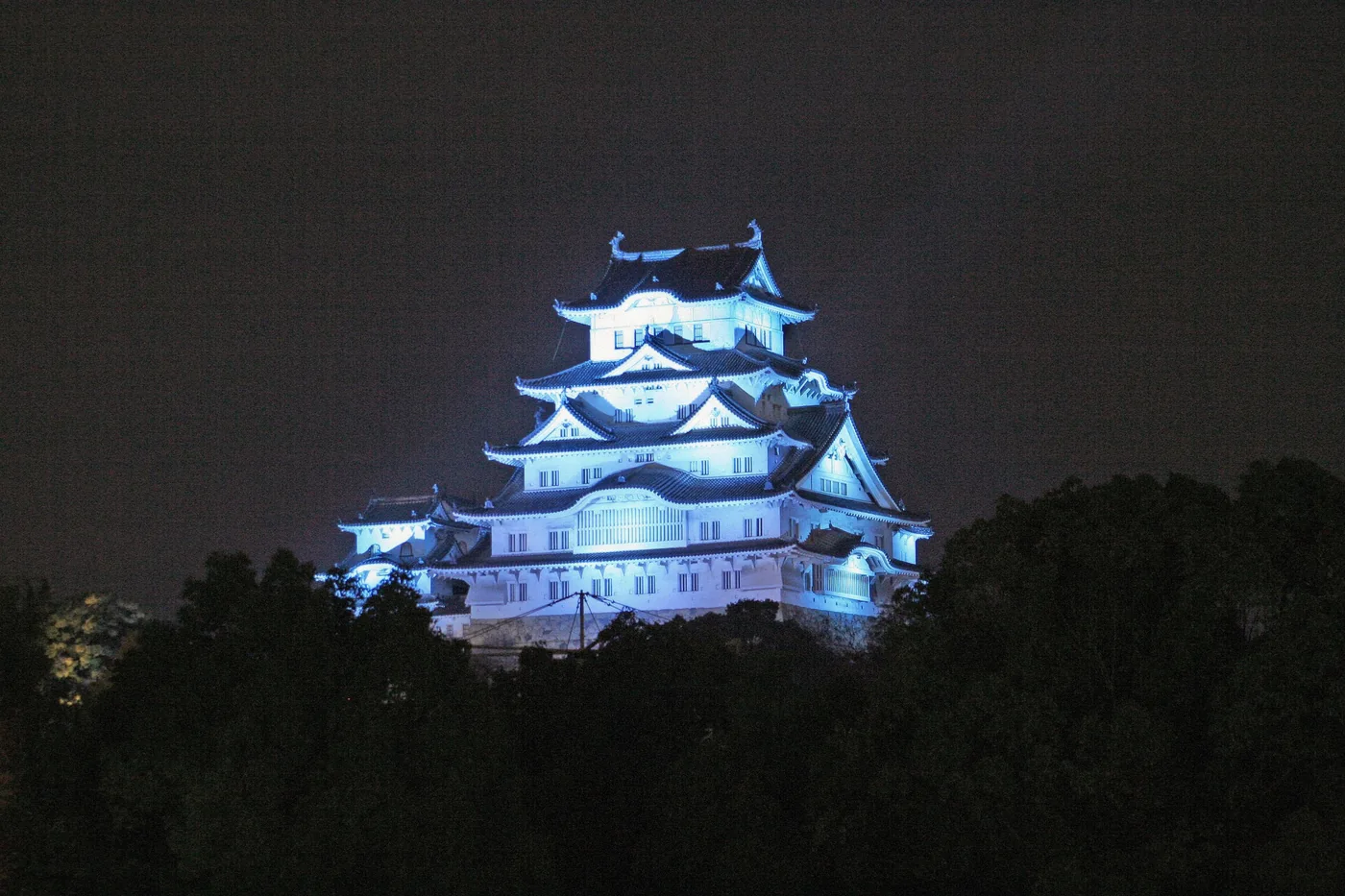
Bloom-week light-up - the free evening show, best after 20:00. Photo: Corpse Reviver, Public domain, via Wikimedia Commons.
Rain and the Bloom Calendar
What rain does to peak week
A spring rain during bloom is a rescheduling event, not a cancellation: petals hold through light rain, drop in heavy it, and a post-rain clear morning is the photographer's lottery - wet petals, blue sky, thinned crowd. The keep runs in rain, the baileys take umbrellas, and the 24-hour cancellation window on every listed tour is precisely the tool for a forecast-driven rebook. The calendar's cruelest outcome - full bloom plus a storm - happens most years somewhere in Kansai; the defence is the trip shape above: a Himeji stay that is excellent at 70 percent bloom, with the castle worth its full price in any weather.
The Dawn, Filmed
An independent 4K dawn walk through the bloom-week grounds - the emptiest and best hour, on video.
The Forecast Chain: From the Agency to Your Booking
Who says when, and when they say it
Japan's bloom forecast is an industry: the meteorological agency tracks theONA mark trees (specified sample trees - Himeji's lives in the city), the major weather services publish their first Kansai forecast in January, refine it through February, and the city-level predictions stabilise by early March. The practical chain for a traveller: book flights against the historical window (the last week of March), book accommodation and tours two months out against the forecast's first revision, and hold the final castle-day scheduling until the March updates - when the ticket strategy matters more than the day choice. Expect the forecast to be right within three days either way; expect the crowd to be the same in all three.
Bloom states, translated
- Kaika (first bloom): a few trees open - photogenic, uncrowded, a week early.
- Mankai (full bloom): the canopy closes - the postcard, the crowds, the whole strategy of this page.
- Chiru (petal fall): the pink snow days - half the crowd, double the melancholy, the moat carrying petals like weather.
Hanami at Himeji: How the Locals Do It
The picnic culture, observed and joined
Bloom week at Himeji is not a queue with a castle at the end; it is the region's largest hanami party, and the locals' playbook is worth copying. Sheets go down in the third bailey from early morning - one sheet per party, unattended sheets are normal and respected - food and drink arrive by cooler, and the day runs nine-to-dusk in the same square metres. Foreign visitors mostly treat the castle as a queue; joining the picnic custom (a sheet, convenience-store supplies, shoes off at the sheet's edge) converts the crowd from obstacle to atmosphere.
The castle's rules are the usual: no music systems, no open fires, take your rubbish - and the third bailey's vending machines will fund the whole enterprise at a markup.
What the stalls sell, and what to skip
The approach lanes run festival stalls through bloom week: taiyaki, grilled squid, the regional sake in cups, and the strawberry-daifuku that every Kansai hanami sells. Eat the squid and the daifuku; skip the espresso (the station's kissaten is better) and buy the sake at the brewery district instead, where the cup is cheaper and the story is real.
Bloom-Week Logistics: Toilets, Buses and Patience
The infrastructure of a very full day
Peak week stresses the plumbing, not the castle: toilet queues at the third bailey run longest 11:00-13:00 (the museum-side facilities are quieter), the loop bus saturates by mid-morning (walk the boulevard - it is faster than waiting), and the nearby parking lots fill before 09:00, which makes the rail approach the only rational one. Cash points: the kiosks and stalls take cash first, cards grudgingly - carry notes. Phone signal holds on the grounds but the reservation systems of the official ticket site slow at peak - screenshot everything the night before.
Photography settings for bloom week
- Morning: the moat rows shoot best backlit at dawn; expose for the blossoms, let the keep go bright.
- Midday: harsh - shoot the stone-and-petal compositions in the baileys' shade lines instead.
- Golden hour: the west walls from Nishi-no-Maru, blossoms rim-lit, the keep warm.
- Rain day: petal-on-stone macro work; the crowd thins, the colours saturate, the keep steams.
- Phone shooters: the keep is white and enormous - tap-down exposure half a stop, or the walls clip.
If You Miss Peak: The Petal-Fall Week
The second-best week, argued honestly
The week after mankai - petal fall - is the connoisseur's secret: the moat fills with drifting pink, the crowds halve overnight, the picnics pack up, and the castle returns to a scale where the stairs breathe. Fresh green follows within days. Travellers locked to April's second half should not mourn the miss: the bloom guide's whole strategy exists because of the peak fortnight, and its absence is a different, quieter castle - one where the official ticket alone covers every need and the guided formats are valued for their stories rather than their crowd management.
The honest ranking for most travellers: peak bloom with a plan, petal fall without one, and ordinary April third.
Booking Lead: The Two-Month Machine
What fills, in what order, at what depth
Bloom week's booking curve is predictable enough to run a countdown against. At two months out, the small-group guided formats are the scarce good: the seven-seat culture walk, the four-seat boat, and the licensed pick's morning slots - these go by calendar, not by luck. At six weeks, hotels inside Himeji city thin out (Osaka and Kyoto remain elastic).
At three weeks, restaurant reservations in the castle quarter tighten for evenings. And in the final fortnight, what is left is what the ticket strategy is built on: the official dated entries and the counter itself, which never run out. The countdown's moral: lock the scarce-and-good early, let the fungible wait.
Cancelling and rebooking inside the window
The 24-hour free-cancellation rule is bloom week's safety valve: a forecast slide can move a guided slot a day without cost, and the platforms' rebooking flow handles it self-serve. The one trap is same-week greed - dropping a confirmed morning slot hoping for a better one that never reopens. In bloom, a held ticket beats a theoretical improvement; the castle's crowd mechanics mean almost any morning works if the alarm is set.
Two Worked Bloom Days: The Planner and the Wanderer
Both work; only one is calm
The planner books two months out (the countdown), holds a 09:00 guided slot with the admission sorted, walks the moat rows at dawn with the crowd's first wave, and spends the picnic hours in the third bailey by choice. The wanderer arrives on a bloom-week Tuesday with an official dated ticket and no bookings: the keep by 09:15, the garden by 11:30, the stalls for lunch, the light-up by accident. Both see the same seven days of pink.
The planner never queues longer than twenty minutes; the wanderer's day is a festival in both senses. The honest advice the reviews support: book the mornings, wander the afternoons - the hybrid is the shape the locals run.
Weather-hold tactics for the peak week
A rain front in bloom week is a scheduling event: petals hold through light rain and drop in heavy it, so the smart hold is lateral, not backward - shift the keep day one day later inside your stay rather than abandoning it, keep the 24-hour cancellation window as the instrument, and spend the wet morning in the sake district or Koko-en's teahouse, which are better companies in drizzle than any staircase. Post-rain clears are the week's photographic prize; the calendar rewards whoever kept a spare morning.
The Bloom Map Beyond the Castle Grounds
If the gates are rammed, the city still blooms
Himeji's sakura is a city-wide event: the Teramachi temple lanes bloom quietly two streets from the crowds, the banks along the Otegawa canal run a long pink corridor popular with locals, and Shukuhaku park (north of the station) holds its own canopy without a keep in sight. For the traveller whose bloom day went to the dawn strategy and still met a wall of people, these are the afternoon's pressure valves - and the sake district's streets carry enough trees that the tasting walk doubles as a blossom walk. The castle owns the postcard; the city owns the comfort.
What the Petals Cost the Operators
Reading bloom week from the listings' side
Bloom fortnight is the operators' harvest: the small-group formats run full calendars at full prices, the certified guides work double shifts, and the boat's city service adds weekday sailings for the season. Reading the market honestly: this is when the ticket-included premium earns its keep (the operator's dated admission against a 40-minute counter line is worth double), when the 24-hour cancellation is most used, and when this site's quarterly price checks matter most - because bloom-week 'from' prices are the ladder's ceiling, not its floor. Book early, compare once, and spend the saved margin on the picnic.
The Petals' Practical Physics
What wind, rain and light actually do
Bloom week's ground truth in three sentences: wind is the petals' clock - a gusty day can strip a canopy that rain left hanging, so a windy forecast moves the peak photo morning forward, not backward. Rain extends bloom by cooling the trees but mats the fallen petals into the gravel - the moat's pink carpet is a post-rain morning phenomenon. And light: the white keep blows out against a bright sky when shot with the blossoms - expose for the walls and let the pink go luminous, or shoot the west walls at golden hour when the balance lands naturally.
Photographers who know the three rules shoot better than travellers with better cameras.
Hanami etiquette, five lines
- Sheets claim space, not fences: an unattended tarp with a bag is honoured - step around, never across.
- Branches are never pulled low for photos - the trees outlive the picture and the fine.
- Rubbish runs home with the picnicker: bins are deliberately scarce during hanami.
- The deer... have no business here - Nara's problems are an hour east; Himeji's hazards are kites and qr codes.
- Drones: banned over the grounds and the moat, enforced quickly - the keep is a national treasure, not a set.
Festival Status 2026: Not Cancelled, Just Booked
Are the Japanese cherry blossom festivals cancelled in 2026?
No - the Japanese cherry blossom festivals run as ever in 2026, Himeji's included: the hanami stalls along the approach, the evening light-ups, and the picnic culture all operating on the usual calendar. What 'cancelled' chatter usually reflects is capacity: the famous viewing hours are crowd-managed, and the practical cancellation risk is yours to misbook - the two-month lead on tours and beds is the only insurance the season asks for.
Bloom Week on One Card
Dates, crowds and bookings at a glance
One table for the fortnight that runs the year: the strategy sections above unpack each row.
| Window | Grounds | Keep queue | Book by |
|---|---|---|---|
| First bloom (kaika) | Sparse, calm | Walk-in | 1-2 weeks |
| Full bloom (mankai) | Festival density | Constant all day | 2 months (tours), 1 month (beds) |
| Petal fall (chiru) | Pink drift, thinning | Short | 1-2 weeks |
| Post-bloom green | Quiet | Short | Days |
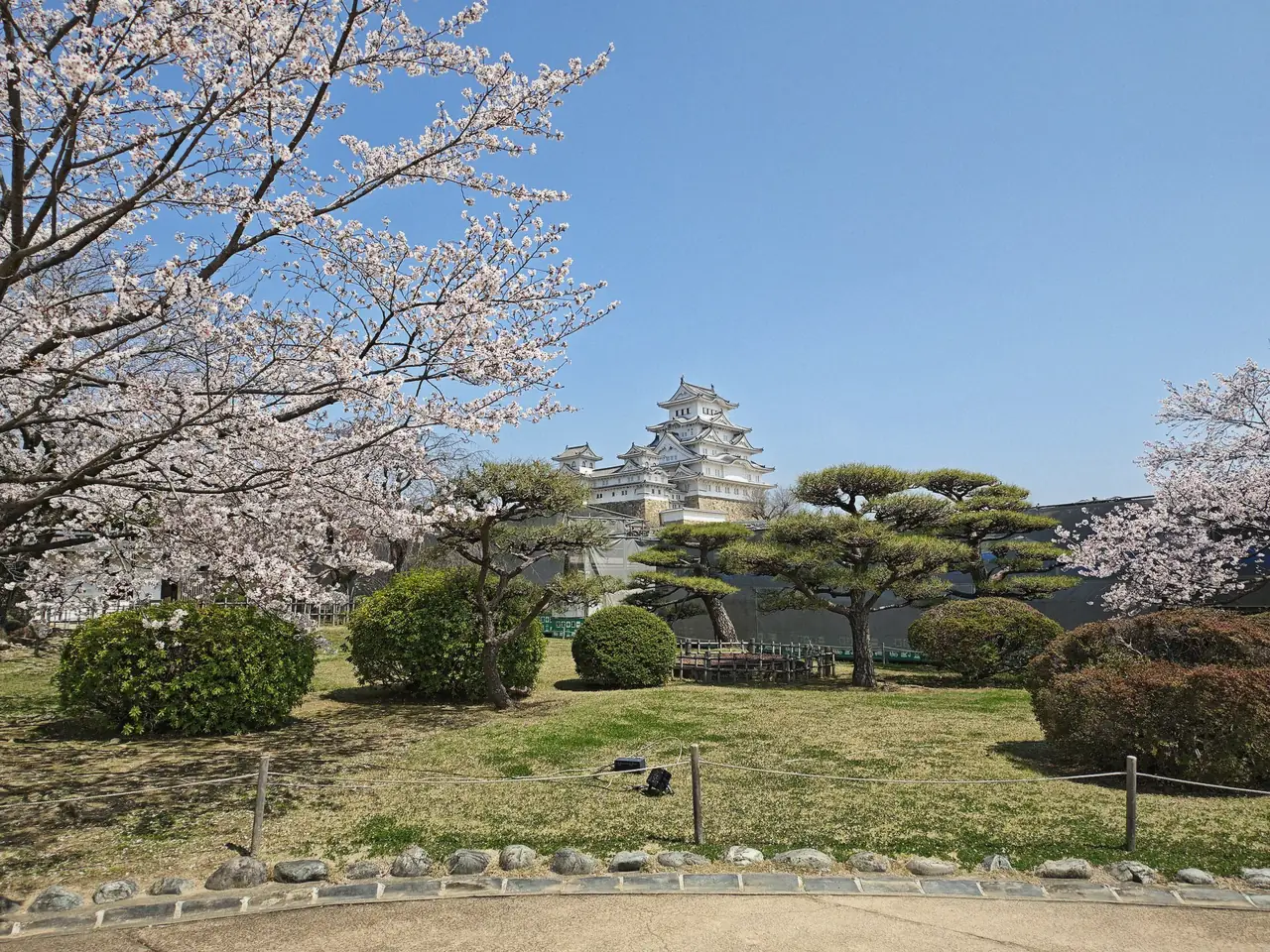
The zoo-side angle: keep over a full pink canopy. Photo: Loggieloggie, CC0, via Wikimedia Commons.
Petal-and-plaster - the week's signature texture. Photo: Seattleite7, CC BY-SA 4.0, via Wikimedia Commons.
Cherry Blossoms at Himeji: Frequently Asked Questions
When do cherry blossoms bloom at Himeji Castle?
Typically late March into the first week of April, with peak bloom lasting about one week. The city publishes its blossom forecast in early March and updates it weekly; treat any earlier prediction as a range, not a date.
Is Himeji Castle good for cherry blossoms?
It is one of Japan's best: roughly 1,000 trees framing an original white keep - the combination the country's bloom photography is famous for. The moat rows, Nishi-no-Maru lawns and third-bailey heart are the three zones that make the classic shots.
How crowded is Himeji Castle during cherry blossom season?
Peak-bloom days run at festival density from dawn to the 16:00 last entry, with the keep's staircase queue constant through the day. The workable strategies: the 9:00 entry with a dated official ticket, the earliest slot on a guided listing booked two months out, or the evening light-up after the day crowd thins.
Do you need to book Himeji Castle tickets in advance for cherry blossom season?
Mechanically no - the castle sells same-day entries throughout - but practically yes: the online dated entry or a tour with admission included converts the hour-long counter queue into a scan or a meet point. At peak week, advance anything is the difference between walking in and standing.
Can you see Himeji Castle's blossoms at night?
Yes - bloom weeks run evening illuminations of the keep and the blossom rows, free to view from the grounds' public edges, with the best hours after 20:00 when the picnic crowds thin. The castle interior is closed by then; treat the evening as a second, lantern-lit visit.